
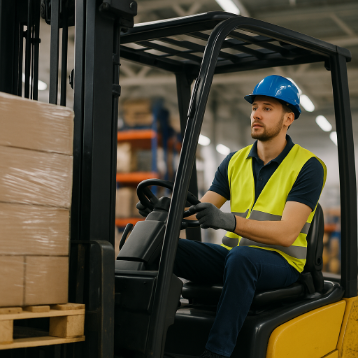
Good forklift operation is never just about moving pallets from one point to another. For new operators, the real foundation is judgment: knowing how the truck behaves, how loads affect balance, how people move through a site, and how small mistakes can quickly become serious incidents. The best forklift operation skills are built through repetition, awareness, and a calm respect for the machine. When those habits are established early, new operators become safer, more efficient, and far more dependable in any working environment.
Start with safety habits and pre-shift discipline
Before a forklift moves an inch, the operator should already be working. One of the most important early habits is treating the pre-shift inspection as a real safety task, not a routine formality. A forklift that looks fine at a glance may still have worn forks, low fluid levels, poor tire condition, faulty lights, or control issues that affect safe operation.
For anyone developing forklift operation skills, this is where professionalism begins: checking the truck, understanding its condition, and refusing to operate equipment that is not safe. New operators should also review the work area before starting, paying attention to floor conditions, aisle width, blind corners, overhead clearance, pedestrian routes, and loading zones.
- Inspect the forklift before use: forks, mast, tires, controls, brakes, horn, lights, steering, and fluid levels.
- Check the environment: wet floors, damaged racking, debris, ramps, dock edges, and restricted areas.
- Confirm the load plan: what is being moved, where it is going, and whether the route is clear.
- Wear required protective equipment: according to site rules and the operating environment.
New operators often feel pressure to prove themselves by working quickly. In practice, the better way to earn trust is to be consistent. A careful start to the shift reduces mistakes later and shows that the operator understands the responsibility that comes with the role.
| Pre-operation focus | What to look for | Why it matters |
|---|---|---|
| Forklift condition | Brakes, steering, tires, forks, mast, warning devices | Mechanical issues can affect control, stopping distance, and load security |
| Work area | Obstacles, pedestrians, ramps, uneven surfaces, poor visibility | Site hazards often create preventable collisions or tipping risks |
| Load suitability | Weight, balance, packaging condition, pallet quality | An unstable or excessive load can shift, fall, or affect truck stability |
Learn precise control before chasing speed
One of the clearest signs of a capable operator is smoothness. Jerky braking, sudden acceleration, and sharp steering inputs make the forklift harder to control and the load harder to stabilize. New operators should focus first on deliberate movement: starting gently, steering progressively, and stopping under control.
Understanding the forklift’s controls is more than memorizing levers and pedals. Operators need to feel how the truck responds when turning, reversing, lifting, and lowering. They also need to appreciate the forklift’s rear-wheel steering, which can surprise beginners because the rear end swings outward during turns. That movement can catch shelving, pallets, or pedestrians if the operator is not watching carefully.
Good control also means managing visibility. If a load blocks the forward view, the operator should travel in reverse when site rules and conditions allow, while continuing to maintain awareness of people, corners, and fixed structures. Horn use at intersections and blind spots is another simple but essential habit.
- Accelerate smoothly rather than abruptly.
- Slow down before turning, not during the turn.
- Keep forks low while traveling unless the task requires otherwise.
- Maintain a safe following distance from other trucks and pedestrians.
- Use the horn and visual checks consistently at crossings and obstructed areas.
Speed can always be added later. Control, once neglected, is much harder to build. New operators who master smooth movement early usually become the safest and most reliable members of a team.
Understand load handling and forklift stability
Load handling is the point where many new operators realize that a forklift is not simply a powered cart. The truck’s stability changes with every lift, turn, slope, and surface condition. A load that is too heavy, poorly positioned, or lifted too high while traveling can make the forklift unstable very quickly.
Operators should understand the basic principle that the load must be centered and secure on the forks. Fork spacing should suit the pallet or item being moved, and the forks should be inserted fully whenever possible. Lifting a load that is off-center or poorly supported increases the chance of shifting, dropping, or damaging goods. It also affects the balance of the truck itself.
Traveling with the load low improves visibility and stability. Tilting the mast correctly helps secure the load, but excessive tilt or careless lifting can create its own hazards. New operators should also treat ramps and inclines with caution, keeping the load oriented appropriately and avoiding sudden changes in speed or direction.
Core load-handling practices
- Check the pallet or load condition before lifting. Damaged pallets and poorly wrapped goods create risk.
- Center the load and keep it balanced across both forks.
- Lift only as high as needed to clear the surface and move safely.
- Travel with the load low to protect stability and visibility.
- Avoid turning with an elevated load, especially in tight aisles or on uneven surfaces.
Stacking and destacking demand extra patience. The operator should approach squarely, align carefully, lift or lower in controlled stages, and confirm the load is stable before backing away. Rushing this part of the job is a common source of product damage and near misses.
Build awareness of people, space, and workflow
Forklift work happens in shared environments, and that means technical skill alone is not enough. Operators need constant awareness of pedestrians, spotters, other vehicles, fixed equipment, and changing site conditions. Warehouses, yards, factories, and loading areas all have patterns of movement, but those patterns can break down quickly when deliveries arrive, aisles fill up, or people cut through active zones.
New operators should learn to read the environment continuously rather than only focusing on the load in front of them. This includes scanning mirrors when fitted, checking both sides before turning, watching overhead spaces, and anticipating what others may do next. Eye contact and clear signaling matter whenever people are nearby.
Communication is part of safe operation. When visibility is limited or space is tight, it is better to pause, ask for guidance, or use a trained spotter than to guess. Professional operators are not the ones who improvise under pressure; they are the ones who know when to slow down and verify.
- Respect pedestrian walkways and exclusion zones.
- Never assume others can see or hear the forklift.
- Reduce speed in congested or noisy areas.
- Stop work if the route, load, or landing area is uncertain.
Turn basic forklift operation skills into long-term competence
The transition from beginner to trusted operator does not happen in a single training session. It comes from steady repetition, feedback, and the willingness to correct small errors before they become habits. New operators improve fastest when they reflect on each shift: where visibility was poor, where handling felt awkward, where space was tighter than expected, and where better planning could have prevented delay or risk.
A useful way to build confidence is to develop a simple mental checklist for every task: inspect, assess, position, lift, travel, place, and recheck. This creates consistency, especially in busy environments where distractions are common. It also helps operators avoid the false confidence that sometimes appears after the first few comfortable shifts.
Safe forklift work is repetitive in the best sense: the same careful checks, the same controlled movements, and the same awareness every time.
Supervision and refresher training also matter. Even promising operators benefit from correction on steering habits, approach angles, parking routines, and load placement. The goal is not simply to avoid incidents, but to develop a standard of work that protects people, products, equipment, and the wider operation.
In the end, the most important forklift operation skills are not flashy. They are the disciplined habits that make safe performance repeatable: inspecting before use, handling loads correctly, moving with control, and staying alert to everyone and everything nearby. New operators who commit to those fundamentals build real confidence, earn trust quickly, and lay the groundwork for a long and capable career around powered industrial trucks.
Find out more at
Forklift Operator Training
https://6916d72041d4b.site123.me/
0875106600
Linpopo
Forklift Training in Thulamela Thohoyandou Thabazimbi Giyani Jane furse
Forklift Training in Thulamela, Thohoyandou, Thabazimbi, Giyani and Jane furse – Please note that all Companies in South Africa MUST only employ licensed forklift Operators and all licensed operators need to provide proof of previous training when inspectors come to your company. In order to book further courses like the refresher forklift training that can be on-site or off-site. Regular Refresher forklift training will ensure that operators are updated on the new legislations, new technologies and it helps them to maintain good driving habits, learn new skills where appropriate, and reassess their skills. Training or retesting may also be appropriate when the operator has the following conditions: We offer free Accommodation for the distant learners so if you are in Gravelotte, Haenertsburg, Hoedspruit, Klaserie, Lebowakgomo, Lephalale, Letsitele, Leydsdorp, Afguns, and Alldays or anywhere in South Africa or the SADC countries we have you covered accommodation wise and our forklift training prices are affordable.
Register for refresher Counterbalance Forklift Training in Thulamela, Thohoyandou, Thabazimbi, Giyani and Jane furse and Limpopo Province as a whole.


